
The history of computers is not a straightforward timeline but a contentious debate over what truly constitutes the “beginning” of computing. Does it start with ancient mechanical devices that performed calculations? Or with the advent of programmable machines in the 19th century? Some argue for the electromechanical relays of the 1930s, like George Stibitz’s demonstration adder, while others point to IBM’s punch card systems or even the invention of the transistor in 1947 as the pivotal moment that birthed modern computing. Historians emphasize that “firsts” in this field depend heavily on definitions (whether a device must be digital, electronic, programmable, or general-purpose), leading to ongoing disputes about priority and invention. This article explores these perspectives, highlighting key milestones and the arguments surrounding them.
A great source on this debate can be found here: https://computerhistory.org/blog/the-neverending-quest-for-firsts/
Ancient and Mechanical Precursors: The Roots of Computation
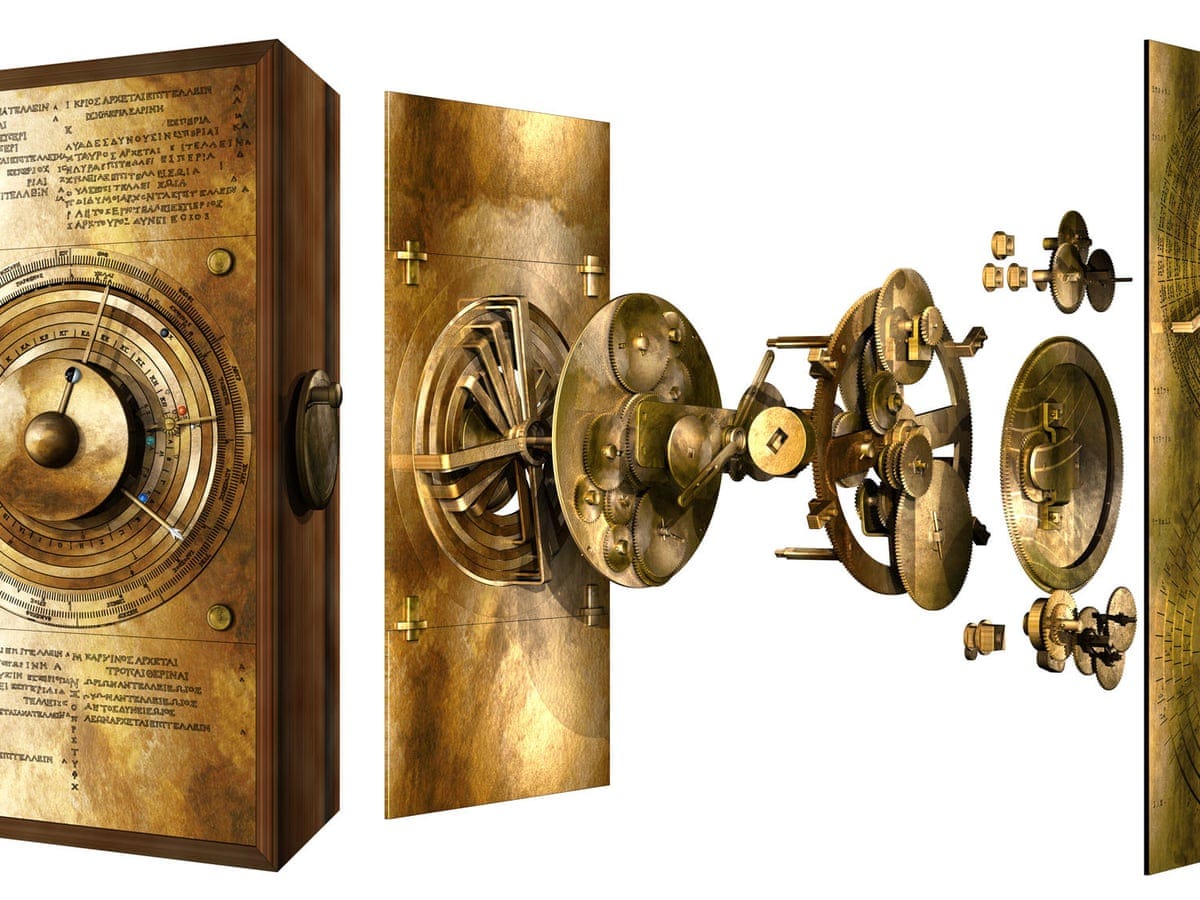
Computing’s origins can be traced back millennia, far before electricity or silicon. The abacus, invented around 2700–2300 BC in Sumeria, was one of the earliest tools for arithmetic, using beads on rods to represent numbers. I have one in my house! The replica kind found in kids toyboxes. In ancient China, the south-pointing chariot from around 1050–771 BC incorporated geared mechanisms, foreshadowing analog computers. The Antikythera mechanism, dated to circa 100 BC and discovered in a Greek shipwreck, is often hailed as the world’s first analog computer, with gears predicting astronomical positions.
In the grounds of my own late fathers hotel, The House of Agnes, was discovered a Quadrans Novus, an astronomical computer, found in a 12th-14th century pit. The piece was somewhat priceless, likely crafted in the 14th century by a metalworker for a traveling clerical scholar.
Debates here focus on whether these qualify as “computers” or mere calculators, as they lacked programmability and relied on manual input.
Moving into the mechanical era, Blaise Pascal’s 1642 calculator and Gottfried Wilhelm Leibniz’s stepped reckoner from 1673 automated basic arithmetic operations. Charles Babbage’s Analytical Engine, conceived in 1837 but never fully constructed, pioneered programmability through punch cards and is widely regarded as the conceptual blueprint for modern computers, with Ada Lovelace authoring the first algorithm intended for it.
A functional replica of Babbage’s Difference Engine №2, built in 2002 from his original plans, stands as a testament to his ingenuity and can be marveled at in London’s Science Museum; a colossal machine embodying sheer industrial might. However, critics contend that Babbage’s designs remained largely unbuilt thought experiments rather than practical origins, often highlighting independent efforts like Percy Ludgate’s 1909 mechanical analytical engine.
The Punch Card Era: From Looms to Data Processing
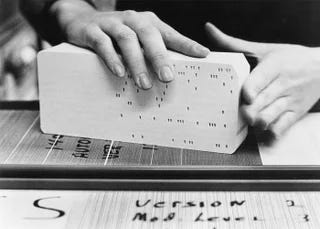
Punch cards represent another contended starting point, bridging mechanical automation and computing. Invented by Joseph Marie Jacquard in 1804 for looms, they stored patterns via holes, inspiring Charles Babbage’s use in his engines. Jacquard looms can still be observed in action today at Richard Arkwright’s historic Cromford Mill textile museum, dating back to the late 18th century. I recently visited Cromford Mill with my children, their eyes widened at the thunderous clanks of the mechanical behemoths, evoking the raw power of the Industrial Revolution.
Herman Hollerith adapted punch cards for the 1890 U.S. Census, creating electromechanical tabulators that processed data far faster than manual methods. His Tabulating Machine Company evolved into IBM in 1924, standardizing the 80-column card format by 1928, which became ubiquitous for data entry, storage, and programming in early computers. At the Cromford Mill you can find a TMC Clocking in/out machine allowing you to touch the roots of one of the largest computer firms in history.
Proponents argue punch cards mark the true source because they enabled scalable data processing, used in WWII code-breaking at Bletchley Park and in IBM’s early electronic computers like the 701. However, detractors see them as mere input media, not the core of computation, and note their origins in textile automation rather than deliberate computing design. In a similar vein, a keyboard is no more a computer than a typewriter is, yet it undeniably serves as a crucial element in a computer's read, write, and memory operations.
Electromechanical Innovations: Relays and the Stibitz Era
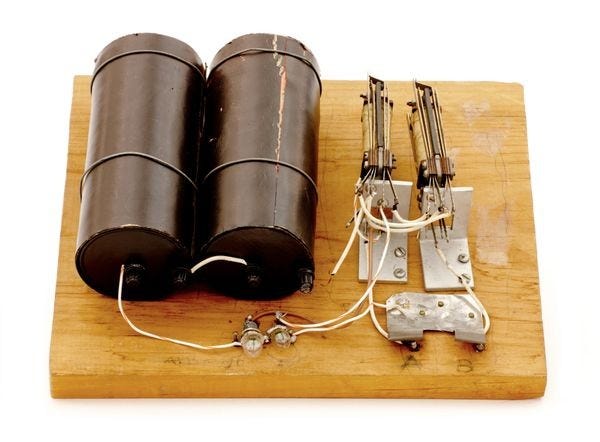
The 1930s brought electromechanical devices, with George Stibitz’s work at Bell Labs often cited as a key transition. In 1937, Stibitz built the Model K adder on his kitchen table using telephone relays, bulbs, and scrap metal to perform binary addition: the first electromechanical computer in America. This led to the Complex Number Calculator in 1939, demonstrated remotely in 1940 via telegraph lines, marking the first instance of remote computing. Of course, the timing was far from coincidental: amid a global race for technological superiority, visionaries with foresight recognised the transformative potential of flexible calculation machines capable of performing thousands of operations per minute; tasks that would otherwise demand days or weeks from rooms full of human calculators.
Stibitz’s relays applied Boolean logic, influencing wartime machines like the Model V general-purpose computer in 1946. Advocates claim this era as the origin because it introduced digital circuits using relays, bridging mechanical and electronic worlds. Yet, others dismiss it as pre-electronic, pointing to Konrad Zuse’s Z3 in 1941 as the first programmable electromechanical machine. This debate underscores one of the most contentious chapters in computing history, often entangled with national pride and claims to innovation: Did the Americans, with their relay-based breakthroughs, truly pioneer the programmable computer, or did the Germans edge ahead with Zuse’s Z3?
The Electronic Age: Vacuum Tubes and Wartime Machines
Electronic computing emerged in the 1940s with vacuum tubes. The Atanasoff-Berry Computer (1937–1942) was the first electronic digital device for solving equations, though not programmable. Prior to this large rooms of human calculators were used to perform detailed operations. The biggest challenge was accuracy. Humans make mistakes and one mistake across 1000’s of calculations could cost either side the war.
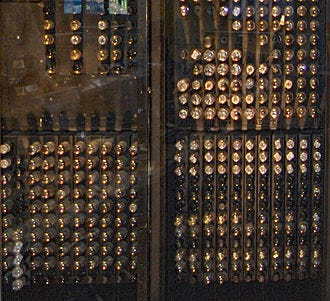
Britain’s Colossus (1943) whilst programmable was a special purpose computer breaking codes electronically. Whilst ENIAC (1945) became the first electronic general-purpose, Turing-complete computer, using 18,000 tubes and occupying an incredible 1,000 square feet.
Debates rage here: A 1973 court ruled ENIAC’s patent invalid due to ABC’s influence, but ENIAC’s practical use in simulations makes it a strong candidate for the first “useful” computer. Critics argue vacuum tubes were unreliable and power-hungry, marking this as a transitional phase rather than the true start. For me personally this is the first true computer. Programmable, holds memory, has output, performs any calculation.
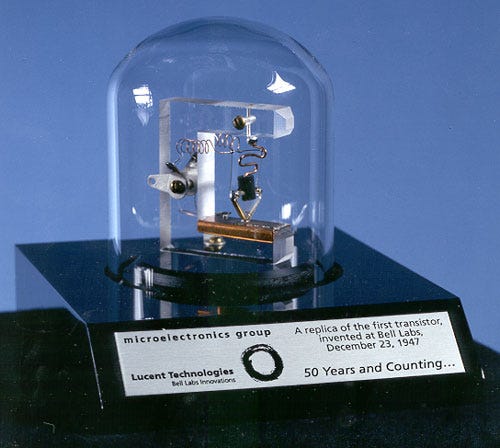
The Transistor Revolution: The Dawn of Modern Computing
The invention of the transistor in 1947 by John Bardeen, Walter Brattain, and William Shockley at Bell Labs is often seen as the definitive origin of contemporary computers. Replacing bulky vacuum tubes, transistors enabled smaller, more efficient, and reliable machines, ushering in the second generation of computers (1956–1963). The first transistorised computer, Manchester’s prototype in 1953, and Japan’s ETL Mark III in 1956, demonstrated this shift.
Supporters argue transistors made computing scalable and accessible, leading to integrated circuits and microprocessors. However, some contend this overlooks earlier foundations, viewing it as an evolution rather than a starting point.
Conclusion: A Continuum Rather Than a Single Source
Ultimately, the “true source” of computer history defies a single answer. It’s a continuum of innovations from ancient gears to silicon chips. Whether emphasizing Stibitz’s relays, IBM’s punch cards, vacuum tubes, or transistors, each milestone built on the last. As historians note, the debate reflects evolving definitions of what a computer is, with no clear winner but a rich tapestry of human ingenuity.
I hope you found this article helpful. I enjoyed creating it and evolving this article which is AI assisted. It is a subject all unto itself and there a a number of sources to this article should you be interested in reading more which I have listed below.
Till the Next Byte,
British Dev’s Diary
Sources:
https://www.historyofinformation.com/detail.php?id=623
https://www.si.edu/spotlight/punch-cards/punch-cards-data-processing
https://www.edn.com/stibitz-demonstrates-remote-computing-september-11-1940/
https://www.ibm.com/history/punched-card
https://www.thoughtco.com/computer-punch-cards-4074957
https://www.livescience.com/20718-computer-history.html
https://home.csulb.edu/~cwallis/labs/computability/
https://www.geeksforgeeks.org/computer-science-fundamentals/history-of-computers/
https://en.wikipedia.org/wiki/Computer
https://en.wikipedia.org/wiki/Punched_card
https://en.wikipedia.org/wiki/George_Stibitz
https://en.wikipedia.org/wiki/History_of_computing
https://en.wikipedia.org/wiki/Transistor
https://computerhistory.org/blog/the-neverending-quest-for-firsts/
https://www.computerhistory.org/timeline/1937/
https://www.computerhistory.org/timeline/computers/
https://www.computerhistory.org/revolution/digital-logic/12/273