
A Million Apps Deep: Promoting Indie Software in the Age of the Flood
What it feels like to market an app you actually built, in the year everyone became an app developer.
Originally published on Medium.
I’ve been building for Apple platforms for the last eight years, shipping iOS apps for clients and, more recently, for myself. I’ve been around technology a good deal longer than that, but in all my time as a developer I have never seen anything like the last 24 months.
Somewhere in 2024, the cost of making an app quietly collapsed. Not the cost of making a good app (we’ll come back to that), but the cost of making an app. Something that compiles, gets an icon, passes review on a quiet week, and lands in the App Store next to yours. Tools like Cursor, Claude Code, Replit and Lovable turned “I have an idea for an app” from a five-year journey into a long weekend. And people took the weekend.
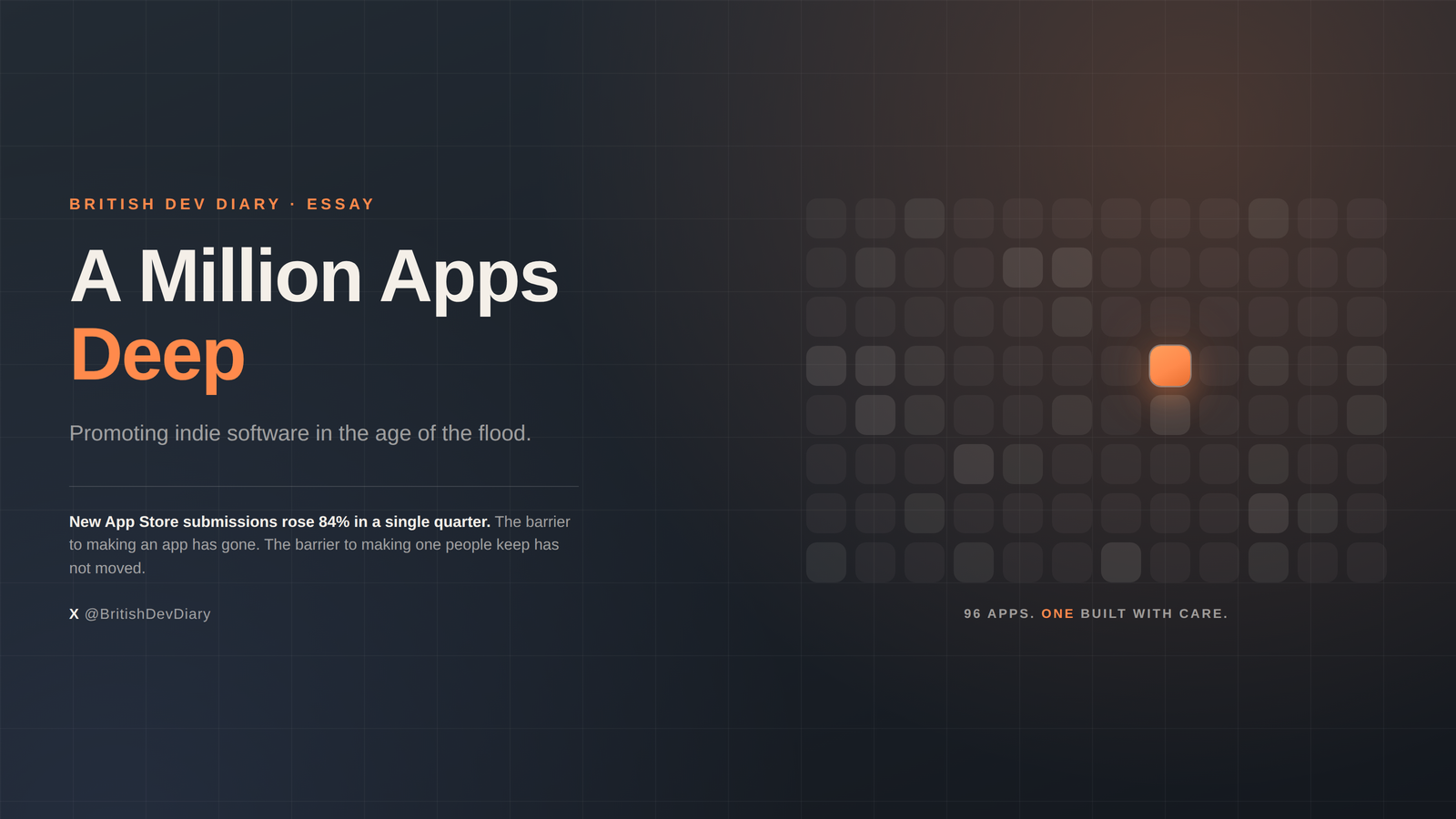
The numbers are hard to believe. In 2025 the App Store logged around 557,000 new submissions, its biggest year since 2016. Then it accelerated. Appfigures data showed new app submissions up 84% in a single quarter. Q1 2026 came in 60% up year-on-year across both stores, 80% on iOS alone, and April was up 104%. Some estimates have Apple on pace for a million new apps this year.
A million. If you’re trying to promote an indie app right now, that’s the sea you’re swimming in.
What the flood actually feels like
From the inside, it’s a series of small indignities. Review times that used to be 24 to 48 hours stretching to a week, sometimes a month, because Apple’s review pipeline was never designed for this volume. Search results in your category silting up with near-identical apps sporting suspiciously confident screenshots. Keywords you’ve patiently ranked for suddenly contested by twelve apps that didn’t exist last month.
And then the properly ugly stuff. A fake Ledger Live clone slipped through review and drained $9.5 million from people’s wallets. Apple has started pushing back hard, blocking updates and invoking Guideline 2.5.2 against apps that generate and run code on the fly. But the crackdown mostly tells you how big the wave is. You don’t build a seawall for a puddle.
The internet has settled on a name for the low end of all this: AI slop. It’s not a kind name. It’s also not entirely wrong.
The uncomfortable argument
The discourse around all this has a patron saint, and it’s Pieter Levels. His take, blunt as ever, is that indie hackers may be the first developers to go extinct. His logic: for twenty years, the moat around an indie product was that building it was hard. Execution was scarce. Now, why would anyone pay $29 a month for your micro-SaaS when an AI agent can recreate a passable version in twenty minutes? What survives, he argues, isn’t coding ability. It’s distribution, branding, and data nobody else has.
Sitting with that as someone whose whole career is built on being good at the execution part is uncomfortable. I won’t pretend otherwise.
But there’s a counter-argument I find more honest, and it goes like this: AI solved the wrong problem. Long before any of these tools existed, surveys of failed indie makers found over 70% citing the same cause of death: “not enough customers.” Not bugs. Not architecture. Customers. AI made building roughly 80% cheaper and made finding users precisely 0% easier. The bottleneck didn’t move; it just got a lot more crowded on the wrong side of it.
In other words, distribution was always the hard part. We just used to be able to hide from that fact behind the difficulty of shipping.
Why I’m not despairing
Here’s the thing I keep coming back to, though, and it’s the reason this essay isn’t a eulogy.
The flood competes at the bottom.
A million vibe-coded apps are, overwhelmingly, apps built by people who don’t know what they don’t know. They ship the happy path. They don’t handle the keyboard covering a text field, or what happens offline, or Dynamic Type, or VoiceOver. They’ve never read the Human Interface Guidelines because they don’t know there are guidelines. The AI that built their app has seen a thousand tutorials and zero taste.
For years, “well-crafted” was a subtle quality. Users felt it but couldn’t name it, and it was hard to market because the baseline was decent. The flood has changed that. When most of what surrounds you in search results is visibly generic, actually good becomes legible. Native polish (proper widgets, Live Activities that behave, an app that feels like Apple made it) has quietly become a differentiator you can see from the screenshots. My own app, TimerStack, lives or dies on exactly that kind of detail, and I’ve stopped thinking of those details as costs. They’re the marketing.
(TimerStack is a routine timer for creators: stack your timers, attach your music, run the routine on screen while you film. I’m taking 20 founding creators into the beta right now. If you film routines, the application is here.)
The other thing the slop era has made valuable is almost embarrassingly analogue: being a person. There’s a growing “made by humans” counter-current in marketing generally, and in dev tools specifically people are starting to call personal branding the most underrated moat there is. When products are trivially cloneable, the developer’s story, judgement and public track record are the parts that can’t be regenerated from a prompt. Years of shipping software that real people rely on is not something you can vibe-code.
What I’m actually doing about it
So the playbook I’ve landed on, for whatever it’s worth, is short and unglamorous.
Build things I’d defend line by line, because craft is now visible from orbit. Show up in the small communities where my actual users live, and be useful there before I’m promotional; broadcasting into the void stopped working, if it ever did. Write openly, under my own name, about what I’m building and why, because the human behind the app is the one asset the flood can’t counterfeit. And stop resenting the wave. The million apps aren’t really my competition. Most of them will be gone in a year, unloved and unupdated. They’re noise, and noise is a problem, but it’s a marketing problem, not an existential one.
The barrier to making an app has gone. The barrier to making something people keep on their home screen for years hasn’t moved an inch. That second barrier is the only one that ever mattered, and it’s still exactly where I left it.
That’s where I’ll be.
If you’re swimming in the same sea
This essay is me practising what it preaches: a real person, building real apps, asking you to come along rather than hoping an algorithm does it for me. Two asks, one small favour.
If you make content, come and build TimerStack with me. TimerStack is a routine timer for creators: stack your timers, attach your music, and run the whole routine on screen while you film. Study-with-me pomodoros, HIIT circuits, stream segments. I’m taking 20 founding creators into the beta, and they get early access, a direct line to me, real influence over what ships, and a promo code for their audience at launch. Applications take about a minute: apply here. If you know a creator who films routines, send them that link and you’ll have done us both a favour.
If you just want to watch the thing get built, follow me on X. I post the real version daily at @BritishDevDiary: what shipped, what broke, what the numbers actually say. The same person, in a longer and better-behaved suit, is on LinkedIn.
And the small favour: Bark Back, my app that listens and responds to your dog, is in open beta and needs dog owners. It takes two minutes to join on TestFlight, and the only feedback I want is the first thing that confused you. Beta chat, new builds and the occasional look behind the curtain all live in my Discord, where anyone is welcome and dog photos are especially welcome.
If you’re building too, reply and tell me what’s actually working for you out there. I read every one.